Identifying Mushrooms
A beginner's overview of fungal anatomy and the absolute rules of safe identification.
The Importance of Absolute Verification
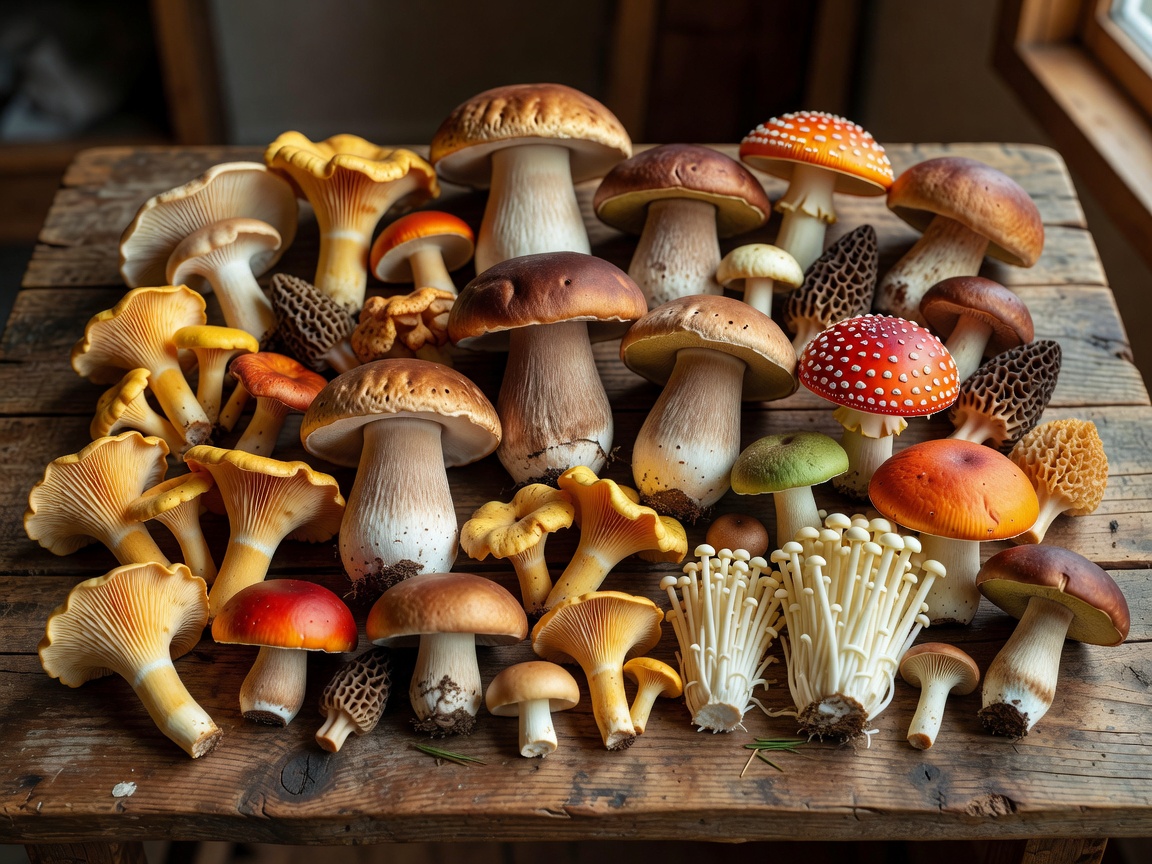
Mushroom foraging is incredibly rewarding, offering access to gourmet ingredients that are impossible to cultivate commercially. However, it is accompanied by severe risks. Unlike plants, where a mistake might lead to a bitter taste or an upset stomach, a mistake in fungal identification can lead to irreversible organ failure and death. The primary rule of mushroom foraging is simple: never eat anything unless you are 100% certain of its identification. Guesswork has no place in the forest. You must be able to confidently rule out every possible toxic look-alike before a wild mushroom enters your kitchen.
Anatomy of a Fungi
To accurately identify a mushroom, you must understand its anatomy. What we call a "mushroom" is merely the fruiting body of a much larger underground network called mycelium. When observing a fruiting body, several key features must be assessed:
- Cap (Pileus): Note the shape (convex, bell-shaped, flat, funnel), color, and texture (smooth, scaly, sticky, velvety).
- Hymenophore (Spore-bearing surface): Look under the cap. Does it have gills, spongy pores, teeth/spines, or a smooth surface? This is often the most critical identifying feature.
- Stem (Stipe): Assess the length, thickness, and color. Does it have a ring (annulus) around it? Does it bruise a different color when handled?
- Base (Volva): You must dig up the base of the mushroom to check for a bulbous sack or volva. Many deadly Amanita species feature this structure hidden just below the soil line.
The Bolete Family: A Safer Starting Point
For beginners, the Bolete family (Boletaceae) is often recommended as an entry point. Instead of gills, Boletes feature a spongy surface under the cap made of tightly packed tubes. The most famous member is the King Bolete (Boletus edulis), also known as Porcini or Cep.
While the Bolete family is generally considered safer because it lacks deadly members, there are toxic species that cause severe gastrointestinal distress. The general safety rules for Boletes include avoiding any that have red pores (the spongy underside) and avoiding any whose flesh stains blue immediately when cut or bruised. While there are edible blue-staining Boletes, adhering to the "no red, no blue" rule keeps novices safe from the problematic species.
Gilled Mushrooms and High-Risk Families
Gilled mushrooms encompass a massive variety of species, ranging from the delicious Chanterelle (which technically has false, fold-like gills) to the lethal Death Cap (Amanita phalloides). Identifying gilled mushrooms requires meticulous attention to detail. You must note how the gills attach to the stem: do they run down the stem (decurrent), attach directly (adnate), or are they completely free from the stem?
The Amanita genus contains species responsible for the vast majority of fatal mushroom poisonings worldwide. These typically have pale gills that are free from the stem, a ring on the upper stem, and a cup-like volva at the base. Avoiding all white-gilled mushrooms as a beginner is a standard and highly recommended safety protocol.
The Spore Print Test
A mushroom's physical appearance can change drastically based on weather, age, and environment, but its spore color remains constant. Taking a spore print is a fundamental skill. To perform this, remove the cap from the stem and place it gills-down (or pores-down) on a piece of half-black, half-white paper. Cover it with a glass bowl to prevent drafts and leave it for a few hours or overnight. The accumulated spores will leave a distinctively colored print. For instance, the highly toxic Galerina marginata has rusty-brown spores, helping distinguish it from edible look-alikes that might have white or purple-brown prints.
Building Your Knowledge Base
No single article or app can teach you everything you need to know about mushroom identification. It requires cross-referencing multiple field guides specific to your region, joining local mycological societies, and spending hours in the woods purely observing. When you start, focus on identifying just one or two easily recognizable species per season. Take photographs, make field notes, and build your confidence slowly. Patience and a profound respect for the complexity of fungi are a forager's best tools.